
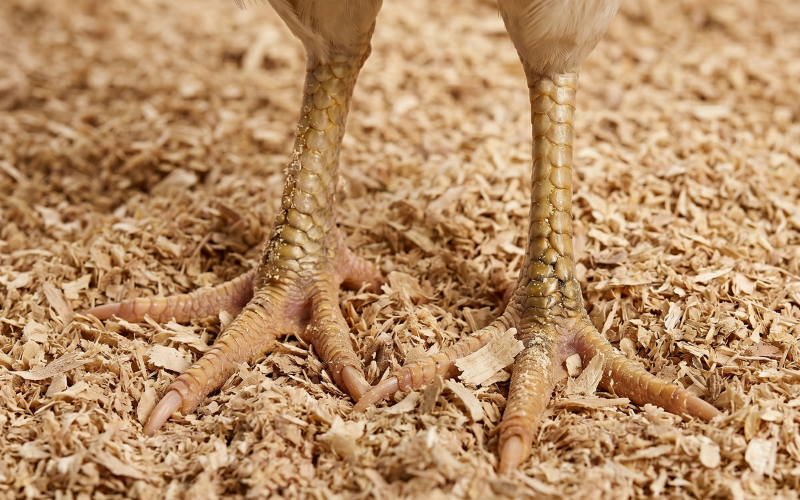
Are you struggling to prevent bumblefoot in chickens with bedding? Maintaining optimal foot pad health is essential for high-production layers, as pododermatitis, commonly known as bumblefoot, remains a major productivity inhibitor. This guide explores the direct interaction between floor material properties and avian foot health, providing actionable management techniques to help commercial operators maximize flock performance and farm profitability.
The clinical pathology of bumblefoot in commercial flocks
Understanding the progression of bumblefoot is essential for any farm manager aiming to eliminate this condition. It is a chronic infection that starts well before the first visible lesion appears on the bird’s foot pad.
The biological progression of foot pad dermatitis
The disease begins when the keratinized layer of the foot pad suffers from physical stress. Continuous contact with hard surfaces, combined with chemical irritation from manure, creates microscopic fissures. These cracks become an entry point for environmental bacteria, specifically Staphylococcus aureus. Once the bacteria enter the subcutaneous tissue, they form an abscess, leading to the hard, swollen nodule we recognize as bumblefoot.

The anatomy of the avian foot and pressure points
To understand prevention, we must look at the digital pads. A hen’s foot pad is a marvel of biological engineering, consisting of a tough outer layer of skin and a fatty, cushioning layer underneath. In high-density settings, the bird spends nearly 100% of its time standing. If the floor material fails to provide adequate support, the constant pressure causes the fatty tissue to compress, reducing blood flow to the pad. This ischemia makes the tissue necrotic, providing an even easier pathway for bacterial invasion.
The role of pressure distribution in foot health
In commercial poultry houses, the surface the poultry stand on must perform two functions: support the poultry’s weight and absorb the physical impact of movement. When the floor material is inadequate, the pressure is not evenly distributed; it concentrates on the weight-bearing points of the foot. If the floor is too soft (causing the bird to sink) or too hard (acting like a concrete slab), the pads are subjected to abnormal biomechanical stress.
Bedding material science: properties that matter
To successfully prevent bumblefoot in chickens with bedding, we must evaluate the material as a functional mechanical interface. Quality is defined by precise technical parameters. When farm managers ask how to prevent bumblefoot in chickens with bedding in humid climates, the answer always lies in the friability of the material.
Technical specifications for optimal foot health
For large-scale operations, we recommend wood shavings that meet the following industrial-grade benchmarks:
-
Size: 1-15mm, providing the ideal balance between surface area and structural loft.
-
Moisture: Max 12%, ensuring the material acts as a high-performance desiccant.
-
Powder matter: Max 1%, critical for protecting the respiratory tract and preventing bedding caking.
-
Foreign matter: Max 0.5%, guaranteeing a safe floor free from hazardous debris.

Friability as the primary metric of success
Friability describes the ability of a material to remain loose and flowable under pressure. A friable material allows the bird’s foot to depress the surface slightly, distributing weight across the entire area of the pad. Our wood shavings are processed to maintain this internal structure. Unlike granular materials that compact into a solid brick, the geometry of our shavings ensures the litter remains breathable and loose throughout the flock cycle.
Moisture-induced structural degradation
Moisture is the primary enemy of friability. When bedding absorbs moisture, the natural structural integrity of the wood fibers begins to break down. By adhering to the max 12% moisture specification, you delay the onset of structural degradation, effectively extending the time the floor remains safe for the poultry.
Comparative analysis of litter materials
When managing an enterprise, comparing litter materials based on their interaction with the bird’s foot is a professional necessity.
Mechanical resistance in diverse litter types
Alternative litters often present significant drawbacks. Paper-based litters tend to become extremely slippery and lose their structural volume within days. Materials like chopped straw often contain coarse, sharp ends that act like needles, creating micro-abrasions. In contrast, wood shavings provide a unique combination of loft, resistance, and softness, creating the ideal poultry foot pad health environment. This makes them the premier soft bedding for layer hens.
The chemical feedback loop: manure and moisture
Poultry manure contains high levels of nitrogen. When this is coupled with moisture, the bacterial breakdown produces high levels of uric acid and ammonia. This chemical cocktail is corrosive to the skin of the foot pad. Our wood shavings serve as a powerful carbon-source buffer, locking the nitrogen into the fiber structure and keeping the surface pH in a safe range.
Advanced management strategies for floor stability
Maintaining the perfect floor environment is a continuous operational process. Relying on the material alone is not sufficient; the application and management are equally important.
The dynamic management of litter depth
We recommend an “active depth” management system. By maintaining a baseline depth of 6cm, you ensure that even as the birds move, the underlying litter provides a consistent cushion. If you notice localized wet spots, they should be removed and replaced with fresh material immediately rather than tilling the wet spot into the rest of the floor.
Microbial population control
The aim is to keep the microbial load at the floor level below the threshold of infection. Using sterile wood shavings with a max 1% powder content is the most reliable way to ensure you are not introducing a new colony of pathogens into the house. By starting with a sterile, low-dust base, the farm manager has full control over the environmental baseline.
Data-driven monitoring of litter performance
Modern poultry management relies on metrics. Managers should track “Litter Moisture Variability” across different zones of the house. By using handheld moisture sensors, you can create a heat map of the litter status. This data-driven approach allows for precise intervention, ensuring that the bedding remains within the optimal 12-15% moisture range.
Advanced troubleshooting: handling unexpected litter challenges
Even with the best materials, unforeseen challenges arise. Here is how experts handle common crises:
-
The condensation trap: In transition seasons, temperature drops cause condensation on the concrete sub-floor. Even the best shavings cannot absorb water rising from below. Solution: Pre-warm the floor before placing the birds.
-
The drinker spill issue: If a leak develops, the shavings will become saturated instantly. Solution: Instead of just tilling, replace the saturated area with at least 5kg of fresh material to maintain the cushion effect.
-
Humidity spike mitigation: During heavy rain or extreme humidity, the litter will naturally absorb more water from the air. Solution: Increase ventilation rates specifically to pull moisture away from the floor surface before it hits the saturation point.
Economic impact of pododermatitis prevention
The primary operational goal of any manager is to prevent bumblefoot in chickens with bedding before it starts. The cost of failing to prevent bumblefoot in chickens with bedding is rarely just the cost of a single bird; it is a systemic loss that affects the entire house performance.
Direct costs vs erformance loss
The direct cost of treating bumblefoot is minimal, but the performance loss is massive. Birds suffering from foot pain spend less time at the feeder and water line. This leads to slower growth rates and reduced feed efficiency. In layer flocks, the stress of chronic pain results in erratic laying cycles. Preventing the condition is a direct investment in the daily efficiency of your farm.
Veterinary management and antibiotic resistance
The industry is moving toward “antibiotic-free” production. Bumblefoot prevention is a foundational element of this shift. If you eliminate the cause, the skin infection, you eliminate the need for the cure, protecting your farm’s ability to maintain high health status without relying on medications.
World Export: Technical bedding engineering
We design our production systems to serve the specific needs of high-production farms. We provide the quality required to prevent bumblefoot in chickens with bedding. We operate 6 factories that focus entirely on the physical consistency of the output to ensure you can prevent bumblefoot in chickens with bedding consistently every single flock cycle.

Precision processing for uniformity
We remove dust, we remove slivers, and we remove impurities. Every shipment is screened to ensure that the material behaves in exactly the same way every time you apply it to the floor, meeting our 1-15mm size and <0.5% foreign matter standards.
Logistics excellence for farm stability
We recognize that the bedding is a critical utility. Our logistics teams are calibrated to manage bulk maritime shipments, ensuring the inventory is onsite before your house cleanup begins.
A commitment to long-term sustainability
Beyond immediate production gains, our wood shavings support circular agricultural economy goals. By using materials sourced from certified sustainable forestry, our partners improve their environmental footprint, which is increasingly vital for audit compliance in the global food supply chain.
Integrating bedding management with nutritional oversight
It is often overlooked that nutrition plays a role in litter quality. Diets high in excessive minerals or certain salts can increase water consumption, leading to wet manure. Coordinating your nutritional program with your bedding management is the next level of operational excellence. Ensure that your feed formulation is balanced to minimize excessive water intake, which preserves the structural integrity of your bedding for a longer duration.
The future of bedding: precision applications
Looking forward, the industry is moving toward automated litter distribution. Our jumbo bag packaging is designed to work with these automated systems, ensuring that your farm is ready for the next generation of poultry management. By combining exact technical material parameters with optimized packing solutions, you can successfully prevent bumblefoot in chickens with bedding.
Contact World Export to receive your wholesale quotation today!
See also: Learn expert methods to reduce ammonia levels in your chicken coop to protect respiratory health and improve overall flock welfare here.
WORLD EXPORT COMPANY LIMITED
No. 35, Street 12, Van Phuc 1 Residential Area, Quarter 5, Hiep Binh Ward, Ho Chi Minh City, Vietnam
Tel / WhatsApp / Kakaotalk: +84 932 632 317
Email: supportwe@worldexport.com.vn